Operational Margin Platform
Ingest Reconstruct Quantify Surface

Find the Real Cost of Resolution.

MarginSignal OS is an operational margin platform for service organizations. We calculate true Cost Per Resolution, detect structural leakage across repeats, transfers, escalations, and rework, and show where recoverable margin is hiding.

Book Diagnostic See Sample Output
Built For: Insurance Claims Ops Healthcare & RCM BPO / MSP

What MarginSignal Is

Diagnostic Engine

Reconstructs full resolution chains from event-level data — tracing every repeat, transfer, escalation, and rework loop to completion.

CPR Economics Model

Assigns dollar impact to hidden friction using resolution-chain reconstruction and operational cost modeling. Every fault line gets a financial exposure number your CFO can act on.

Monitoring Layer

Flags drift, repeat demand, escalation pressure, and transfer inflation over time. Continuous visibility into margin health — not a one-time report.

Methodology Informed By
COPC CX Standard ICMI Frameworks HDI Best Practices Deloitte Digital McKinsey Operations
12
Structural Fault Lines Mapped
$35+
Avg CPR Gap Per Resolution
3x
Findings Guarantee on Signal Scan
Zero
Baseline Period Required

Why General BI Misses Margin Leakage

Your BI team builds dashboards. We reconstruct resolution chains and assign dollar impact to the friction hiding inside them.

General BI (Tableau, PowerBI)

  • Shows averages and lagging metrics
  • Requires custom modeling by internal teams
  • Doesn't reconstruct full resolution chains
  • Reports what happened — not what it cost
  • No CPR recovery model out of the box

MarginSignal OS

  • Maps issue resolution from first touch to actual closure
  • Quantifies repeat demand, transfers, escalations, and rework
  • Assigns dollar impact to every fault line
  • Flags structural leakage and drift continuously
  • Diagnostic value without heavy integration

Why can't my data team build this in-house?

Resolution-chain reconstruction is not a default BI model. It requires tracing every contact from first touch to final closure across systems.

CPR economics requires operational domain logic, not just dashboarding. SQL alone doesn't assign dollar impact to behavioral fault lines.

Fault-line mapping takes 15 years of operational pattern recognition, not a sprint with your analytics team.

Time-to-value is weeks, not quarters. Internal build cycles take 3-6 months to scope, build, validate, and get executive buy-in.

What the system actually produces

See Sample Output

MarginSignal OS turns operational telemetry into an executive view of margin health, drift signals, proof windows, and fix accountability.
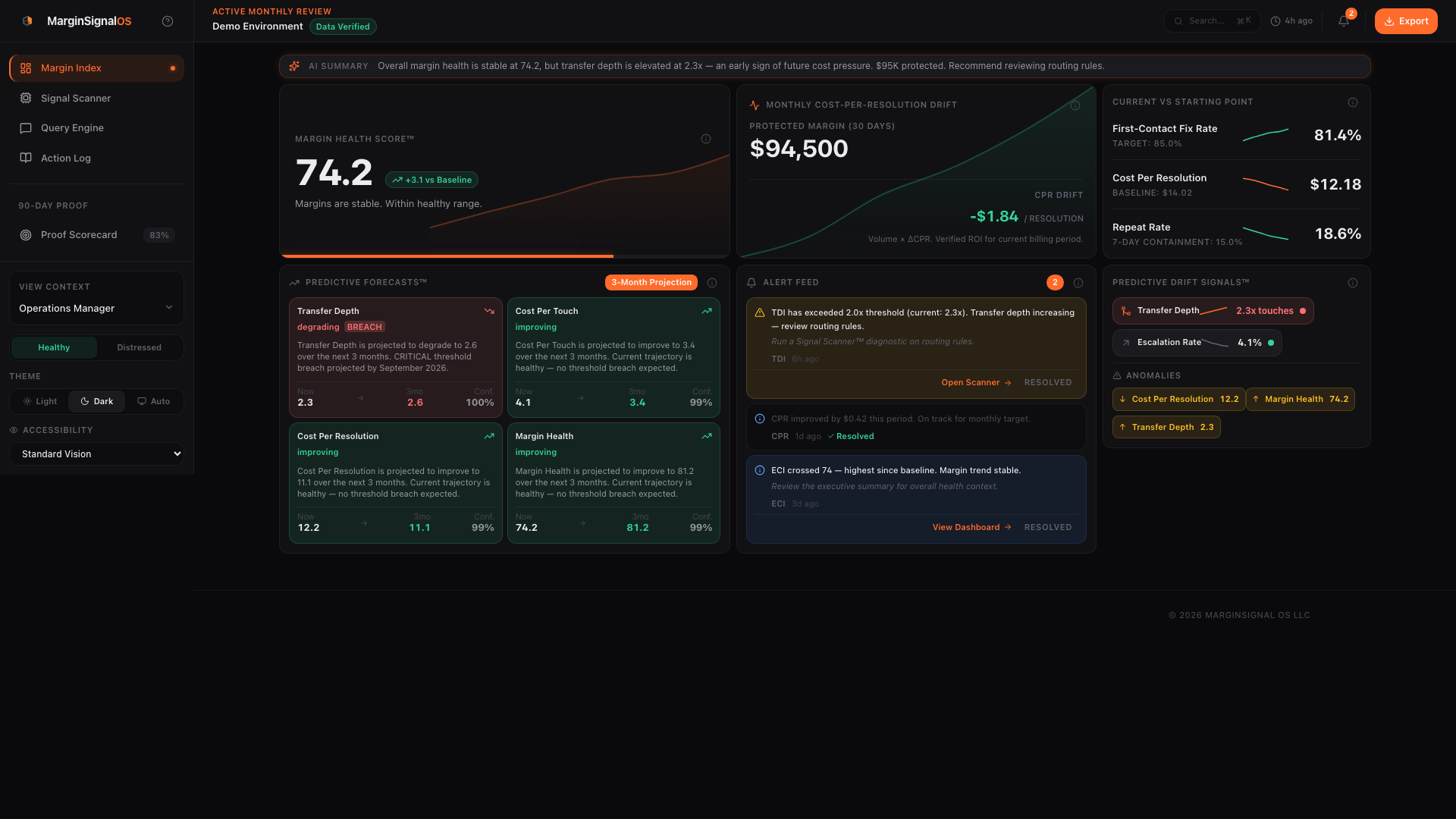
MarginSignal OS full dashboard showing Margin Index at 74.2, CPR drift chart with $94,500 protected margin, alert feed, predictive forecasts, and executive operating context

Illustrative sample environment. Margin Index dashboard showing margin health, CPR drift, alert conditions, predictive signals, and operating context in a single executive view. Click to enlarge.

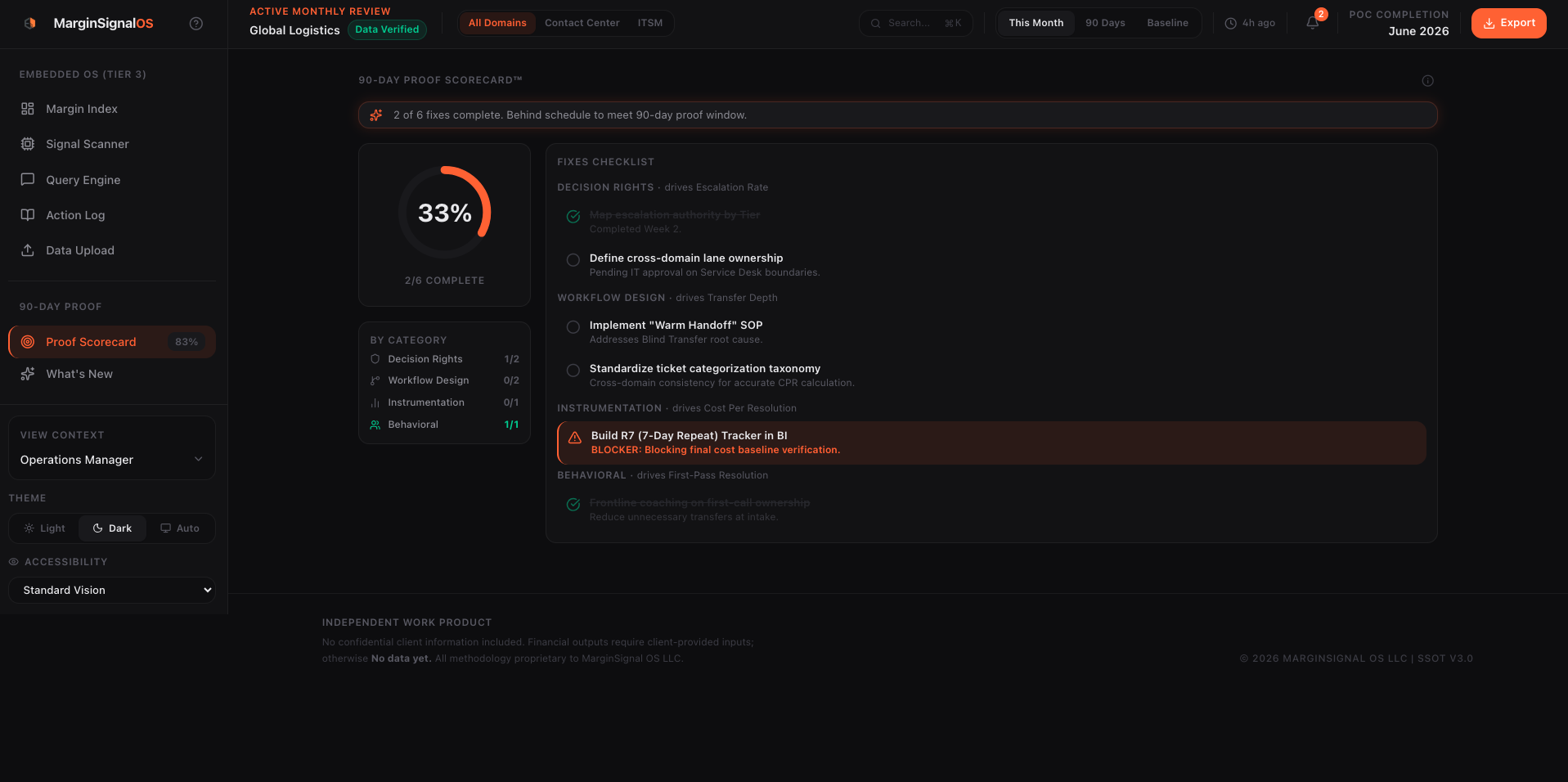
90-Day Proof Scorecard showing 2 of 6 fixes complete with fix accountability across decision rights, workflow design, instrumentation, and behavioral categories

Illustrative sample environment. 90-day proof scorecard.
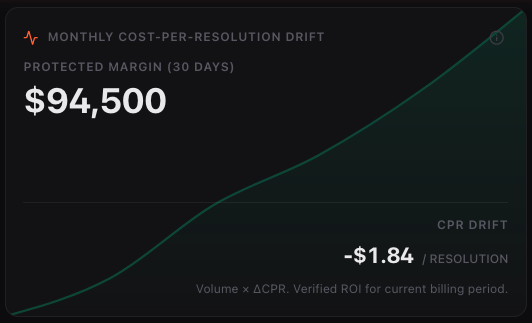
Monthly Cost-Per-Resolution Drift chart showing $94,500 protected margin over 30 days with -$1.84 per resolution drift

Illustrative sample environment. CPR drift view.
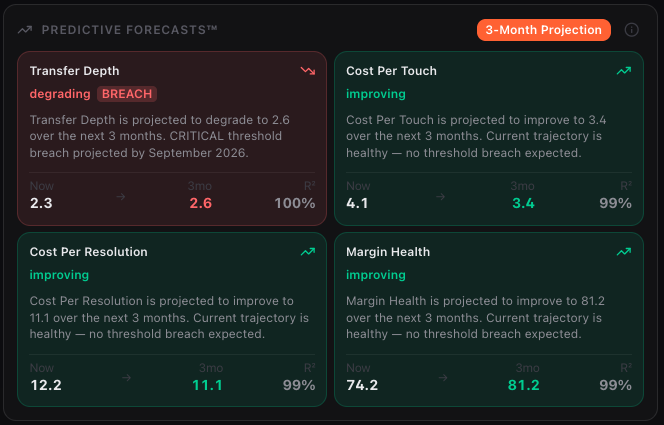
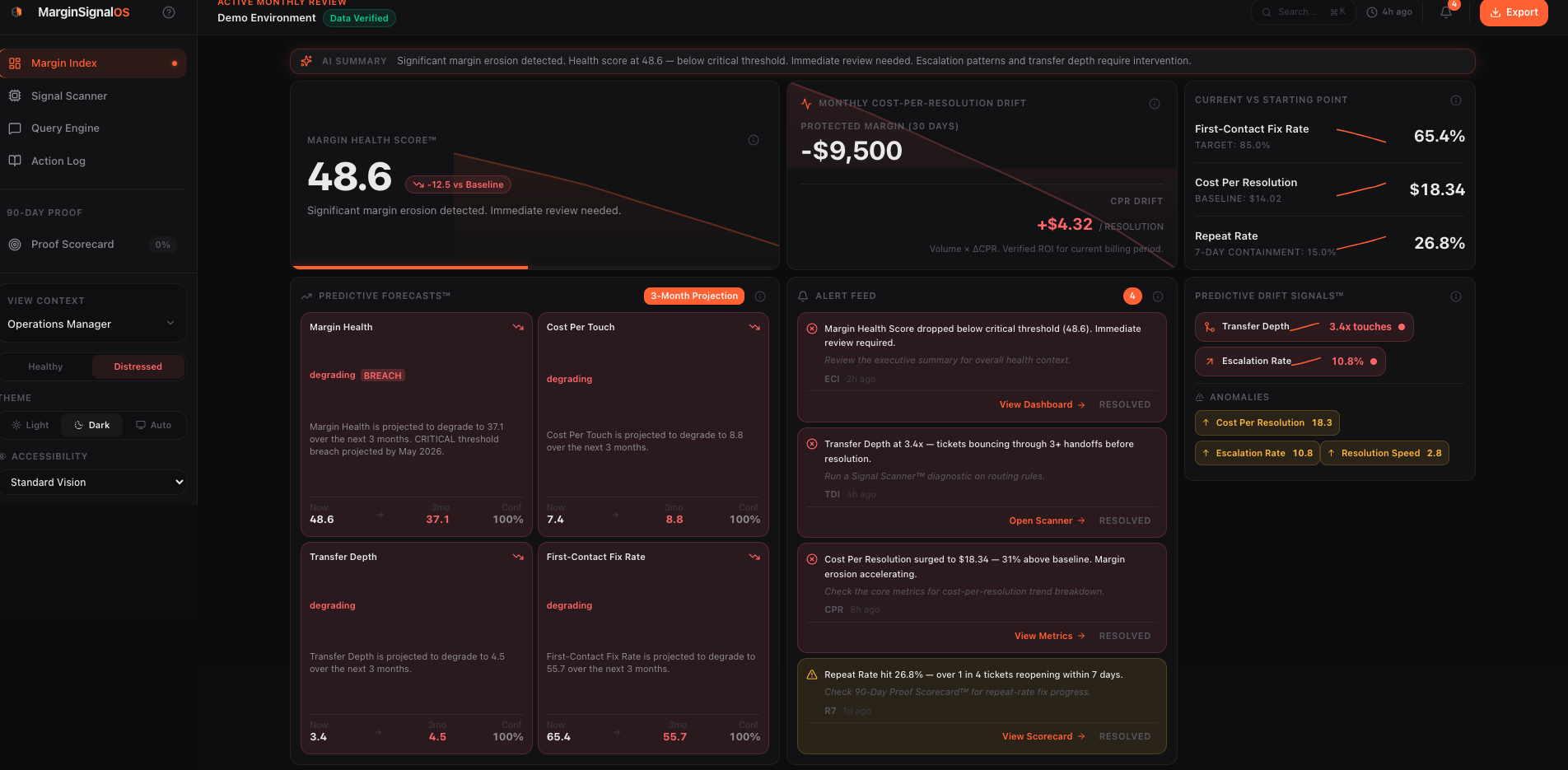
Predictive Forecasts showing 3-month projections for Transfer Depth, Cost Per Touch, Cost Per Resolution, and Margin Health with threshold breach warnings

Illustrative sample environment. Predictive forecasts.

Available as part of the Signal Scan and Margin Diagnostic workflow.

See full sample deliverable set

The Problem Nobody Is Measuring

Your dashboards may be tracking activity without exposing resolution economics. The margin erosion happening inside repeat contacts, transfer chains, escalation loops, and dispatch revisits rarely surfaces in standard reporting.

These friction patterns compound silently — a 3% repeat rate is not 3% waste. It is 3% compounding across every resolution chain, every day, in every domain you operate.

The Signal Gap

Why Dashboards Miss Structural Leakage

What The Dashboard Shows
Average handle time: 7.2 minutes (Stable)
What It Doesn't Say (Floor Reality)

22% of interactions required a callback within 7 days.

The callbacks averaged 12 minutes.

3 of them escalated (Authority Misalignment).

1 dispatched a truck.

That "7-minute interaction" actually cost you 47 minutes of operational capacity and a $180 truck roll.

The Diagnostic Framework

We map 12 operational Fault Lines to our CPR (Cost Per Resolution)™ economics model. Built from your operating data, not generic industry averages.

Baseline-Free Delivery From Day 1
MSOS Output Terminal // 12-Card Set
The Pivot Point Structural Fault Line Predictive Driver Financial Impact
Transfer Count > 2 Ownership Diffusion Across Handoffs Transfer Depth AWAITING...
Escalation Returned Escalation Bounce (Authority Misalignment) Escalation Bounce Rate AWAITING...
Revisit within 14 Days Field Revisit Normalization 7-Day Repeat Rate AWAITING...
01 // DIAGNOSE

12 Fault Line Cards

We map your telemetry against 12 structural fault lines — the recurring patterns that inflate resolution cost. No 8-week baselining period required.

02 // QUANTIFY

CPR Economics™

Every repeat contact, transfer chain, and escalation loop has a dollar value. We calculate the true Cost Per Resolution — not per call, per resolution — so you see what it actually costs to make a customer issue go away.

03 // CONTAIN

Behavioral Playbooks

Every Fault Line is assigned a "Moves-First Metric." We deploy behavioral coaching kits and 30-day containment plans giving leaders exact architectural corrections.

Live AI Scanner

Test the Diagnostic Engine.

Don't wait for a 4-week consulting engagement. Describe an operational symptom you are experiencing on the floor right now, and our engine will map it to a structural Fault Line.

Or try a common signal:
MSOS // Cognitive_Gate_0

Awaiting Telemetry

Case Study

What a Diagnostic Actually Finds

Real numbers. Real fault lines. Real margin recovery.

P&C
Regional P&C Insurance Carrier
2,000 agents | Claims & Policy Servicing

"$1.2M in annual leakage they didn't know existed."

FCR reported at 78% — within target. But 22% of interactions generated a repeat within 7 days, and transfer chains were inflating handle times across every queue.

The diagnostic mapped their data against two fault lines — Ownership Diffusion and Escalation Bounce — and surfaced $1.2M in structural margin loss that had been invisible to their BI team for over two years.

VP of Claims Operations
Regional P&C Carrier, Southeast US

Diagnostic Findings

7-Day Repeat Rate
22.0% 18.5%
Escalation Bounce Rate
8.4% 3.2%
Cost Per Resolution
$47.20 $38.60
Annualized Margin Recovered $1,240,000

"We had 14 dashboards. Not one of them showed us the $1.2M we were losing to repeat contacts and transfer chains. The MarginSignal diagnostic found it in three weeks."

— VP Claims Operations

Request a Sample Executive Briefing

See exactly what a diagnostic delivers — before you commit.

Findings Guarantee

Every Signal Scan is backed by a findings guarantee: if we do not identify verified leakage equal to at least 3x the engagement fee, we refund the fee.

Zero-Trust Compliant

No API integrations. No database access. Built for low-friction security review using anonymized CSV exports via a secure browser uplink.

Fast Time-to-Value

No multi-week baselining period. The CPR model generates findings from existing operational data, typically within the first engagement week.

How MarginSignal Is Delivered

Not software-only. Not consulting-only. A productized diagnostic that scales from first assessment to continuous monitoring.

Step 1

Entry Point

Start with a free CPR Calculator or a $500 Diagnostic Readiness Assessment. Estimate your exposure in 48 hours with zero integration.

Free Calculator $500 Assessment
Step 2

Diagnostic Engagement

Signal Scan or full Margin Diagnostic. We ingest your data, reconstruct resolution chains, and deliver ranked fault lines with dollar impact.

Signal Scan Margin Diagnostic
Step 3

Platform Layer

Dashboard access, drift monitoring, alerting, audit trail, and ongoing executive review. Continuous visibility into margin health — not a one-time PDF.

Dashboard Drift Alerts Audit Trail

What Happens After the Diagnostic

This is not a one-time report. It is the beginning of continuous margin visibility.

CPR Drift Monitoring

Ongoing tracking of Cost Per Resolution trends. See whether fault lines are contracting or expanding month over month.

Structural Alerting

Automatic alerts when repeat demand, transfer inflation, or escalation pressure crosses governance thresholds.

Executive Review

Periodic proof tracking and executive briefings tied to verified margin recovery. Evidence your CFO can take to the board.

Pricing

Every engagement ties to verified margin recovery. Findings guarantee on every Signal Scan.

Most teams start with a Signal Scan to quantify hidden resolution cost before committing to a larger diagnostic or pilot.

Get Started

Same Day – 48 Hours
Free or $500

Start with the free CPR Calculator (60 seconds, benchmark estimate) or upgrade to the $500 Diagnostic Readiness Assessment for a fault-line breakdown with a 15-minute findings call.

  • Estimated Cost Per Resolution
  • Industry Benchmark Comparison
  • Annual Leakage Estimate
Recommended

Signal Scan

2–4 Weeks
$15k – $25k

Forensic diagnostic mapped against 12 structural fault lines. If we do not identify verified leakage equal to at least 3x the engagement fee, we refund the fee.

  • Ranked Fault Line Cards
  • CPR Baseline + Financial Model
  • Diagnostic Dashboard
  • Executive Briefing
  • 3x Findings Guarantee
Request Signal Scan

Margin Diagnostic

4–6 Weeks
$25k – $35k

Everything in the Signal Scan plus a full CPR financial model, internal vs. BPO cost comparison, coaching dashboard, and a 30-day containment plan with implementation roadmap.

  • Everything in Signal Scan
  • Full CPR Financial Model
  • Internal vs. BPO Comparison
  • 30-Day Coaching Action Plan
Start Diagnostic

Enterprise & BPO networks: For multi-site deployments or performance-based gain-share engagements, contact us for custom scoping.

What You Need to Get Started

30 days of anonymized data
CSV exports accepted
No API integration
Intake under 1 hour
First review within days

Frequently Asked Questions

Do you need direct integration with our CRM/Telephony databases?
No. The MSOS Diagnostic is built to be baseline-free and InfoSec friendly. We do not require complex API integrations or weeks of IT security reviews. We can run our CPR economics model using standard, anonymized CSV exports of your operational telemetry via a Zero-Trust browser uplink.
How much time will this require from my management team?
Minimal. Our entire philosophy is that "Data Insufficient is a feature, not a bug." We do the heavy analytical lifting. Your team only needs to provide the raw exports and attend a 60-minute Executive Briefing where we present the containment strategy.
We already have a BI team. Why do we need MSOS?
BI teams are excellent at building dashboards that show you averages. However, BI teams are rarely operational practitioners. MarginSignal OS doesn't just display data; we map the data to 12 specific human behaviors and translate that behavioral failure into a CFO-ready financial exposure model.
The Process

How the Signal Scan Works

Clear assumptions. Defined logic. Auditable outputs. From raw data to recoverable margin.

1

Data Ingestion

30 days of anonymized interaction data. Standard CSV exports. No IT integration required. Encrypted transfer via secure upload link.

2

Resolution Mapping

Every interaction traced from first touch to final resolution. Rework loops, escalation cascades, and handoff friction quantified at the dollar level.

3

Leakage Heatmap

10-slide executive briefing showing exactly where margin is hiding. Each leakage point quantified against COPC 8.0 benchmarks and industry standards.

4

Remediation Roadmap

Prioritized action plan with dollar values. 30/60/90 day implementation targets. Every recommendation tied to a specific recoverable amount.

Built for Enterprise Review

Security & Handling
  • Anonymized CSV intake
  • No live system integration
  • 72-hour data wipe certificate
  • E&O insured
Engagement
  • Founder-led diagnostic
  • Executive briefing included
  • Sample output available
  • 90-day proof window
Commercial Assurance
  • Findings guarantee
  • U.S. Patent Pending
  • CAIQ-aligned controls
  • Terms available on request
Brandon Burdin, Founder of MarginSignal OS
Atlanta, GA

Brandon Burdin

Founder & Product Architect

  • 15 years in contact center operations
  • Led teams from 50 to 2,000+ seats
  • Insurance, healthcare, BPO, ITSM, field service

MarginSignal OS exists because I got tired of seeing operations report Cost Per Call at $8 while the real Cost Per Resolution was $43. The gap is structural, not seasonal. I built the diagnostic to find it.

Sample Artifact

What a Fault Line Card Looks Like

Fault Line #01

Field Revisit Normalization

Critical
Predictive Driver

7-Day Repeat Rate: 22%

Annual Exposure

$1,200,000

Behavioral Root Cause

Adjusters closing claims as resolved while 22% generate a second site visit within 14 days. Each revisit costs $180-$400 in direct dispatch plus reprocessing. Logged as new contacts, making them invisible to FCR reporting.

Recommended Containment

30-day coaching intervention on resolution verification protocols. Moves-First Metric: reduce 7-day repeat rate from 22% to 18% within first cycle.

Representative sample from a regional P&C insurance carrier diagnostic. See full sample output →

Start Here

Request a Diagnostic

Every engagement is led directly by the founder and scoped for hands-on execution.

Request Received.

I'll review your details and reach out within 24 hours to schedule a brief scoping call.

Your Dashboard Says Green.
Your Margin Says Otherwise.

The gap between Cost Per Call and Cost Per Resolution is structural. It compounds daily. And it is invisible to every dashboard in your building. We find it.